Category Archives: writing

To Plot or Not To Plot

Lately in the conversations on my writing lists it seems there are two types of writers.  Those who like to sit down at the page and just start writing words till something happens, and those who plot and do background, then write.

Are both valid methods of writing?  Well, sure.  There is nothing to say that the book one of those writers turns out won’t be just as good as the other’s.  I do believe, however, that there will be a difference in the amount of time those books take.

There is a minimum amount of plotwork that has to be done on any story if it’s going to hang together, and have a point, and a logical series of events.  You can do that plotwork before you start, or while you’re going.  The trouble with doing it while you’re going is that you have to stop moving the story forward while you do it, and sometimes the things you find out while you’re doing your plot and backstory work will require changes, and sometimes flat-out removal, of things that were already written.

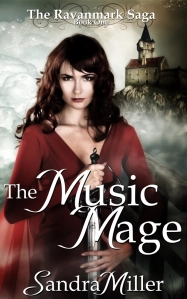
I’ve written both ways.  The Music Mage actually started that way, just writing scenes with only a vague story concept.  The characters I figured out as I introduced them, the magic surprised me as much as anyone else.  But then as I kept working, and the story kept evolving, and the plot became more complex, I had to stop and do my background work.  I had to figure out what exactly the rules of this magic were, what exactly the cost was to use it, what exactly the limitations were.  Some things that happened way before the story itself were becoming important, and I needed to know more about exactly what they were.  And when I finished, some of the stuff I found had to be worked in to the material that was already written.

It wasn’t all bad, of course.  A lot of things just fell into place like puzzle pieces, even though I hadn’t consciously planned them that way.  It is exciting to watch the plot develop and unfold.

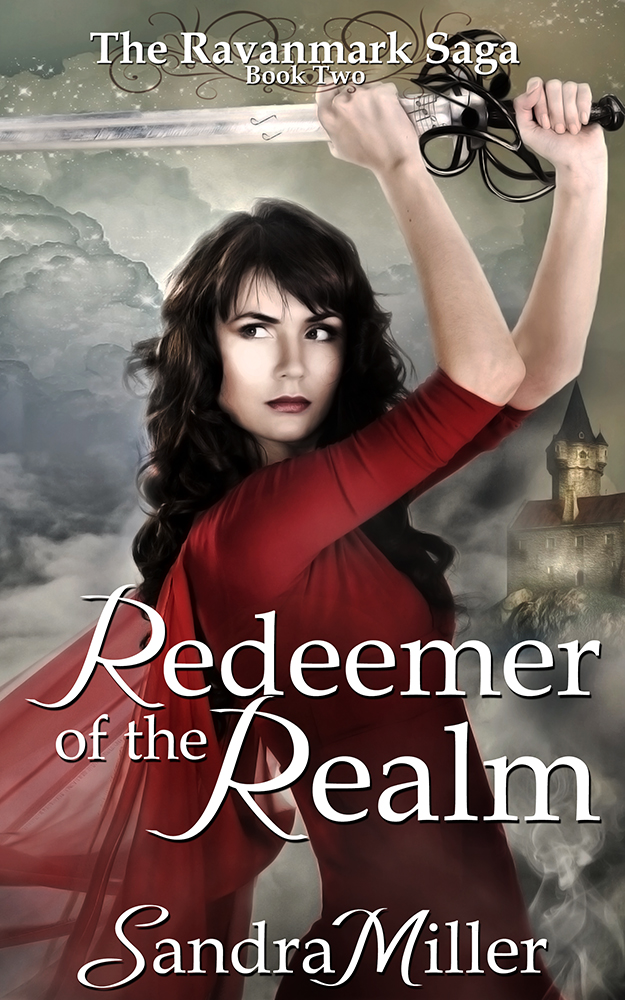
Redeemer of the Realm has been totally different.  After doing the last half of the first book with everything plotted out and the background done, I couldn’t see starting the new book any other way.  So I did the outlining, the plot synopsis, and everything else I could think of before I started.  And the book is moving faster, a lot faster.

But even doing your homework first doesn’t mean you won’t occasionally have to stop and do more.  Maybe you didn’t figure out everything you needed to know, maybe there are new scenes that have occured to you that you want to work in.  For whatever reason, you may still find yourself stopping at times to go back to your notes, and make new ones.

So I guess the moral is that you can’t avoid doing your homework.  You can put it off, but in the end, if the book is going to make it, you’re going to have to get the dirty work done.

And so goes another lunch break…

 

Taking Your Show On the Road, Part II

One of the posts on my old blog that I always got questions about in email, was Taking Your Show on the Road. I consistently get questions about managing your writing when you are on the move, and that post summed up pretty well how I did it, at the time.

Only thing is, you may notice that post is dated 2005.  Tech that was only slightly less than new at the time is pretty well outdated now.

I’m pretty sure the clamshell handheld method would still work, assuming I could get Active Sync working with Windows 7.  Still, the method has some problems for me now that forced me to find something new.

  1. A few years ago I switched to Dvorak keyboard layout, as one of several changes I undertook to help me deal with carpal tunnel syndrome.  Some of those things I don’t have to do anymore, as the situation has gotten better, but Dvorak is one change I have stuck with.  And Windows CE, at least the old versions on those clamshell devices, did not support Dvorak.
  2. You may remember those devices had no hard drive–only RAM.  So if the battery ran down, you lost everything.  This wasn’t necessarily a huge problem–until the battery, which was already old when I got it, reached a point where it didn’t want to hold a charge for any predictable length of time.  Batteries can be replaced, but it seemed it might be time to seek a better solution.
  3. Again related to the RAM–the whole device is setup to be a mobile, temporary copy of something that is permanently stored elsewhere (like on the desktop you sync to).  It seemed to me that with today’s tech, it should be possible to have the primary device also be the device you carry with you.

For a while I carried an Asus Eee pc, which was cute, but also had a few drawbacks–the keyboard was too small to touchtype comfortably, slow bootup times, and the SSD drive was too small to use the machine as a real laptop.  It also had some idiosyncrasies with the wireless connectivity, and the keyboard had an unfortunate tendency to double or triple input letters that you typed.  I haatedd seeeingg thhis…

So what I’m using right now is the Lenovo IdeaPad you see at the beginning of this post.  (You can see it’s convertible to a tablet…I think I’m just a sucker for gadgets–I have no earthly use for the tablet part…if I was buying again tomorrow I would probably find something a bit less expensive that didn’t have the touchscreen.  It is very cool, though.)  It’s small enough to fit in my (admittedly large) purse, it has a full-size keyboard I can touch-type on, is robust enough I can use it for other things if I need to, I can carry my manuscript, notes, maps and databases with me, and it spends all it’s time in sleep mode so it comes up quickly when I’m ready to write.  The touchpad is my biggest gripe–this one is really hard to use effectively.  But I find that even when I am home, I just pull this machine out and write on it.  So all of my work is in one place, and I can take it with me anytime, everywhere I go.  Which is what I wanted all along 🙂

The Timelessness of Writing Advice–Book Recommendation #1

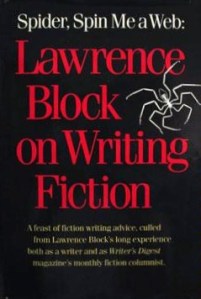
I recently caught sight of one of my favorite books on writing, sitting on my book shelf, and on a whim decided to re-read it.

Yes, I know the book I’m showing you was published in 1988.  I bought my copy from a used bookstore when I was in college, and I have kept it ever since.

And still, after all these years, it is one of my very favorites.  (Did you know they came out with a Kindle edition a few years ago?  Neither did I!  If you click on the picture, it should take you to it.  I’m getting a copy for my Kindle, right.now.)

Lawrence Block writes mysteries–at the time, I didn’t even read mysteries.  I read a few of his novels, but only after reading his books on writing.  I read his books on writing after getting hooked on his column that ran for many years in Writer’s Digest–I still have a stack of old issues that I pull out sometimes.

You will find books of genre-specific writing advice.  Lawrence Block’s books are not those books.  His advice transcends genre.  He takes on some of the more esoteric topics others don’t often talk about, like foreshadowing that can be done after the fact, the large role of intuition in writing, and the simple fact that the way words look on a page is important.  A lot of this is not nuts-and-bolts advice (I have other books I’ll recommend for that!)

But it is timeless.  I was thinking about it this morning, after one of my kids wondered aloud why I was reading such a old book.  I could find something newer to read, but I doubt I could find something better to read.

The simple fact is that, while genres and writing styles may come in and out of fashion, the techniques of putting words on the page don’t really change.  This book was written when writing was done on typewriters, when Kindles didn’t exist, when the world was a different place.  And it doesn’t matter at all.  The advice is still sound.  Lawrence Block’s entertaining, humorous, engaging style works as well today as it did in 1988.

If you’re in the mood for some good reading (and some good thinking) about writing, give this one a shot.

Endings–A Practical Exercise

A while back I posted a blog entry on the old blog (reposted below for your convenience) about endings.  There is also a new article on my website (Endings) on the same topic.

So, taking into consideration all of the things discussed there, how can you be certain your ending is carrying your story’s weight?  I’m not sure there is a one-size-fits-all answer to that question, but here are some exercises that may help.  These are all things I conceived of myself, when working on a big story that encompasses several books, but still needs to be coherent & complete when it’s all said and done.

  • Exercise #1–Beginning, Ending, Change Worksheets

    In this first exercise, we’ll take a straightforward look at your ending.  You can do this whether your book is complete or not–if it is not yet complete, just use the ending as you currently imagine it.  Any problems with that ending will probably be shaken out as you work through this.

    We’re going to sit down with three sheets of paper.  On the first sheet, write “Beginning” at the top.  Now, list out the elements of your story as they stand at the beginning of the story.  You’ll want to include your main character’s situation, any important supporting characters’ situations, the main problem in the story and any secondary problems, the setting where we find your characters–etc.  Essentially you are summarizing the state of your fictional world in this list.

    On the second sheet, write “Ending” at the top.  On this sheet you will list out all of those same elements–only this time, you’re going to list out how they stand at the end of your story.  Everything you had on your first sheet should make an appearance here, plus any significant developments over the course of the story that must be handled in the ending.

    The third sheet should be labeled “Change”.  Up till now we’ve been making lists that are pretty automatic–all the material for them is already laid out in your manuscript or in your head, and you are just putting it down on paper.  This is the sheet that will require you to really think.  I’m about to ask you a question that you may find tricky.

    Look at the first item on your first sheet.  Probably your main character’s situation, right?  Now look at the first item on your first sheet.  It’s your main character’s situation at the end of the story.  What change is necessary to make this happen?

    When you have an answer for that, start your list on the third sheet.  Put a #1 on the top line, and list out any and all changes that are necessary to accomplish this ending.  (If this is confusing, don’t worry, there will be an example later.)  A single item on your beginning and ending lists may require several changes–that’s okay, just list them all out.  Then move on to the next item.  It will take some time.  Just keep going, I’ll wait.  🙂

    All done?  Good!  What you have now are cheat-sheets to your entire book.  Assuming the beginning is accurate as you have laid it on sheet 1, and your ending is accurate as you have laid it out on sheet 2, then sheet 3 contains the bare bones essential plot to get you from one to the other.

    This is crucial.  Sheet 3 is not the entire plot of your novel.  Of course not.  But Sheet 3 contains the essential things.  The things that must happen, for story reasons, for your ending to work.

    Now your work may be easy.  If all of the things contained on Sheet 3 are already in your plot, you are done here.  Your ending grows organically out of your story, and it makes sense.  Good job!

    If not, you have more to do.  If elements on the sheet are missing, these are areas where your ending will be weak.  It will not grow out of the story, because the things leading to it were not adequately explained.  You’ll need to look for ways to work these missing elements into your story.

    You may find, when you attempt to do that, that elements already in your story flatly contradict things that are on Sheet 3.  This is a bigger problem.  Basically, you are in a situation where, for your ending to make sense, a certain thing needs to happen.  But for your plot to work, that thing can’t happen.

    You have a choice here–something will have to change.  You can change the ending so that the missing element is no longer necessary.  You can change the beginning, so the missing element is already taken care of at the story outset.  Or you can change the plot, so that the missing element can be added without breaking the story.

    Whatever you choose, your end goal is a situation where Sheets 1 and 2 accurately represent your story’s beginning and end, and where everything on Sheet 3 happens in your story.  At that point, you can be reasonably certain you have an ending that follows logically from your story, that makes sense.

Good work!  A bit heavy for a blog post, though, eh?  My website has a page of examples to illustrate this. To see the examples, check out:

Endings–Examples

Endings

Here’s the thing: Endings.  Endings are the thing.  Endings are Every Thing.

At least when you are writing.  Or reading.

Ending is not the cherry on top.  Ending is so integral to your plot, you can’t separate them.  At least, not if you want to write anything anybody wants to read.

The Ending is what you’ve been selling the whole time you planned, plotted, backstoried, character developed, and wrote your Great American Novel.  A good ending won’t save a wretched story.  But a bad ending will unfailingly kill a good story.  The ending is why the reader just invested their valuable time reading your story, and if it stinks, then they’ve wasted that time.  Your ending has to be good, or your story is doomed.

So what do I mean by a Good Ending?  Does every story have to end with Happily Ever After?

No.  Of course not.  Good does not necessarily mean happy.  But it should be satisfying.  It should resolve the conflict, and tie up the main storyline and any secondary storylines you had.  The ending should grow organically out of the plot and the action of the story, not come screaming out of left field at the reader, who can find no other justification for it than the whim of the author.

Want to find out more about Endings?  Check out the new article on my website at

Endings